Gymnastics is often seen as a sport reserved for young children or elite athletes performing on television during the Olympics — but that perception leaves out a huge part of the picture. In reality, gymnastics is one of the most effective ways to build total-body strength, flexibility, balance, and coordination, and it’s far more accessible to beginners of any age than most people assume. Whether you’re considering it for your child, thinking about starting as an adult, or simply curious about incorporating gymnastics-based training into your existing fitness routine, this guide covers everything you need to know before your first session.

Why Gymnastics Builds a Foundation Other Sports Don’t
Most sports specialize in one or two physical qualities — running builds cardiovascular endurance, weightlifting builds raw strength. Gymnastics is unusual in that it simultaneously develops strength, flexibility, balance, coordination, and body awareness, often referred to as “proprioception.” This is part of why gymnastics is frequently used as a foundational training method for athletes in completely unrelated sports, from football to figure skating. Learning to control your own bodyweight through space translates into better movement quality everywhere else in life.
What a Beginner Class Actually Looks Like
Contrary to the image of beginners immediately attempting flips or working on balance beams, a genuine beginner gymnastics class starts much more conservatively. A typical first class includes:
- A structured warm-up, usually involving light cardio and dynamic stretching to prepare joints and muscles
- Basic conditioning exercises, such as planks, hollow holds, and simple bodyweight strength drills that build the foundation needed for more advanced skills later
- Fundamental movement patterns, like forward rolls, cartwheels, and basic balance work on a low beam or the floor
- Flexibility work, targeting the hips, shoulders, and spine, which are essential for injury prevention as skills progress
Coaches typically assess a beginner’s current strength and flexibility during the first few sessions and build a personalized progression from there — nobody is expected to arrive with any prior skill.
Common Beginner Movements Explained
- Forward and Backward Rolls — The most basic gymnastics skill, teaching body control and spatial awareness while rolling along the floor. This is usually the very first skill taught, even to adult beginners.
- Cartwheels — A sideways rotation that develops shoulder stability and coordination. Most beginners spend several sessions perfecting the basic mechanics before moving to more advanced variations.
- Handstands (Wall-Supported) — Rather than jumping straight into a freestanding handstand, beginners typically practice against a wall first, building shoulder and core strength while learning proper alignment.
- Bridge Pose — A backbend stretch that develops spinal flexibility and shoulder mobility, both essential for many advanced gymnastics skills down the line.
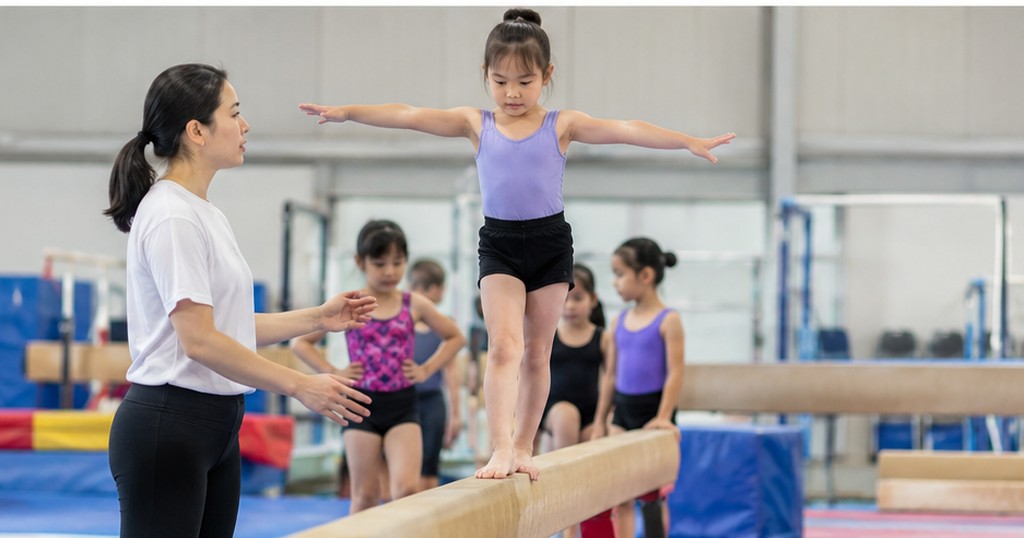
- Basic Balance Beam Work — Often done on a low beam just a few inches off the ground initially, focusing on walking, simple turns, and basic balance rather than any acrobatic elements.
How Gymnastics Differs for Kids vs. Adults
For children, gymnastics classes are often structured around long-term skill progression, since kids typically have significant natural flexibility and lower injury risk from falls. Classes tend to move at a pace that builds toward more advanced skills over months and years.
For adults, the approach usually shifts. Many adult beginner classes focus more heavily on strength, flexibility, and fundamentals rather than pushing toward advanced acrobatic skills quickly. This isn’t a limitation — many adults find gymnastics-based conditioning (sometimes marketed as “gymnastics strength training” or “GST”) to be one of the most effective ways to build functional strength, even without ever attempting a back handspring.
What to Expect in Terms of Physical Demands
Beginners are sometimes surprised by how physically demanding gymnastics is, even at the introductory level. Core strength in particular gets worked heavily and consistently, since nearly every skill — from a simple handstand to a basic roll — depends on a stable, engaged midsection. It’s common to feel sore in your abs, shoulders, and hip flexors after your first few sessions, even if the movements themselves looked simple.
Safety Considerations for Beginners
- Always warm up properly before attempting any skill, even something as basic as a forward roll
- Use spotting and mats provided by your gym, especially when learning new skills — don’t rush to attempt something unsupported
- Listen to your coach’s progressions rather than trying to skip ahead to skills you’ve seen more advanced gymnasts perform
- Build flexibility gradually — forcing a stretch before your body is ready is one of the most common causes of injury in the sport
Frequently Asked Questions
Is it too late to start gymnastics as an adult?
No. While competitive elite gymnastics typically requires starting young, recreational and fitness-focused gymnastics is genuinely accessible at any age. Many adults start purely for the strength and flexibility benefits, with no intention of ever competing.
Do I need to be flexible before I start?
Not at all — flexibility is something you build through consistent practice, not a prerequisite. Most beginners, both kids and adults, start with quite limited flexibility and improve significantly within a few months.
How often should a beginner train?
Most beginner programs recommend one to two sessions per week to start. This allows enough recovery time between sessions while still building consistency and skill retention.
The Bottom Line
Gymnastics offers a genuinely unique combination of strength, flexibility, balance, and body control that few other activities can match — and it’s far more approachable for true beginners than its elite, televised version suggests. Whether your goal is competitive skill-building, general fitness, or simply trying something new, starting with the fundamentals and progressing patiently under proper coaching is the path nearly every gymnast, at every level, has taken.
#ad